Friday, June 3, 2016

Leonard Cohen - Suzanne (live at the Montreal Jazz Festival 2008)


“Suzanne,” Leonard Cohen
“Suzanne,” Leonard Cohen.THE MUSE: Suzanne Verdal.THE BACKSTORY: Originally a poem, "Suzanne" was inspired by Cohen's attraction to the ethereal Verdal, who lived on the Saint Lawrence River in the mid-'60s. She later described their friendship as "a spiritual union." Said Cohen, "Everyone was in love with Suzanne." In recent years Verdal, a former dancer, became homeless, drifting between Montreal and Venice Beach.

"Suzanne" is a song written by Canadian poet and musician Leonard Cohen in the 1960s. First published as a poem in 1966, it was recorded as a song by Judy Collins in the same year, and Cohen performed it as his debut single, from his 1967 album Songs of Leonard Cohen. Many other artists have recorded versions, and it has become one of the most-covered songs in Cohen's catalogue.
In 2006, Pitchfork Media listed the song #41 on their list of "The Top Songs of the 1960s".

Background[edit]

"Suzanne" was inspired by Cohen's platonic relationship with Suzanne Verdal, the then-girlfriend of sculptor Armand Vaillancourt. Its lyrics describe the rituals that they enjoyed when they met: Suzanne would invite Cohen to visit her apartment by the harbour in Montreal, where she would serve him Constant Comment tea, and they would walk around Old Montreal past the church of Notre-Dame-de-Bon-Secours, where sailors were blessed before heading out to sea.[3]
Verdal was interviewed by CBC News's The National in 2006 about the song. Verdal says that she and Cohen never had a sexual relationship,[4]contrary to what some interpretations of the song suggest. Cohen stated in a 1994 BBC interview that he only imagined having sex with her, as there was neither the opportunity nor inclination to actually go through with it.[5] She says she has met Cohen twice since the song's initial popularity; once after a concert Cohen performed in the 1970s and once in passing in the 1990s when she danced for him, but Cohen did not speak to her (and possibly did not recognise her). Verdal never benefited financially from the song's enormous commercial success.[6]
Cohen has stated that he was duped into giving up the rights for the song, but stated that he was glad it happened, as it would be wrong to write a song that was so well-loved and to get rich for it also.[7]
Its lyrics first appeared as the poem "Suzanne Takes You Down" in Cohen's 1966 book of poetry Parasites of Heaven, admittedly because of lack of new material. Lyrics to a few other songs from his subsequent 1967 debut album were also printed in the book.

Recordings and cover versions[edit]

The song "Suzanne" was first performed by The Stormy Clovers in 1966 and then recorded by Judy Collins, appearing on her 1966 album In My Life. It was later released by Cohen on his debut album Songs of Leonard Cohen.
Other notable early versions were by Noel Harrison, whose recording was a minor hit,[8] and in 1969, Herman van Veen's Dutch version reached fourth place on the Dutch Top 40 list. Anni-Frid Lyngstad ("Frida" of ABBA fame) also recorded a version of the song with Swedish lyrics by Owe Junsjö for "Frida", her 1971 début album
It has since been covered by many other artists,[1] including a young Bruce Springsteen in his band the Castiles.[9]
Samples from "Suzanne" have also been used: Robert McKay used lines from Cohen's poem as chapter titles in his 1969 young adult novel Dave's Song. Verses of the song are played intermittently throughout the 1974 movie The Second Coming of Suzanne, starring Sondra LockePaul Sand,Jared Martin and Richard Dreyfuss. Rapper Plan B sampled the song for his Paint It Blacker mixtape, detailing a fictionalised account of a prostitute killed by the Camden Ripper and dumped in the river. The band R.E.M. gave Cohen a joint songwriting credit for their song "Hope" (on their 1998 album Up), in light of the similarity between the two songs. R.E.M. describe themselves as realising that similarity only after completing the song.
The French singer Alain Bashung made a cover of the song tranlated into French for his album "Bleu pétrole" (2008).

Use in the media[edit]

Film[edit]

The song forms the opening and closing theme for the 1974 film "The Second Coming of Suzanne"
The song forms the theme for the final scene of Cohen's short movie I Am a Hotel, released in 1983.
It is also used in one of the intermezzos in Lars von Trier's Breaking the Waves.
Nick Cave performed the song in the film Leonard Cohen: I'm Your Man.
The song is featured in the Werner Herzog movie Fata Morgana.
The song is featured in A Home at the End of the World (2004).
The song is played as a slow-motion backdrop to film of Bill Clinton and Monica Lewinsky in Adam Curtis' 2011 documentary All Watched Over by Machines of Loving Grace.
The song is played in the 1987 Icelandic movie Skytturnar where a woman plays the song on her stereo, but the two main characters are dissatisfied with the song and instead play an Icelandic country song.
The song is featured in the final minutes of Robert Altman's "McCabe and Mrs Miller".
The song is featured in Jean-Marc Vallée's 2014 American biographical drama film Wild.
SUZANNE 

You Probably Think This Song Is about You

BBC Radio 4 FM, June 1998

Suzanne Verdal McCallister interviewed by Kate Saunders

Transcription from tape by Marie Mazur
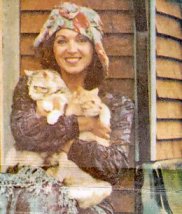

"Suzanne Verdal perches in the doorway of the little gypsy cabin
she and her son built on the back of a truck".
Suzanne left Montreal in 1992 with his son Kahlil.


Narrator: Now, "You Probably Think This Song Is about You" and a trip back to the early 60�s in Montreal to meet a young dancer married to Armand, a handsome sculptor. She became the muse of dozens of Beat poets but for one, Leonard Cohen, she became extra special.
Suzanne takes you down
to her place near the river
you can hear the boats go by
you can spend the night beside her
And you know she�s half crazy
Suzanne: The Beat scene was beautiful. It was live jazz and we were just dancing our hearts out for hours on end, happy on very little. I mean we were living, most of us, on a shoestring. Yet, there was always so much to go around, if you know what I mean. You know, there was so much energy and sharing and inspiration and pure moments and quality times together on very little or no money.
Saunders: Do you remember exactly when you met Leonard Cohen? Where were you that night, do you remember?
Suzanne: It was maybe several months into my relationship with Armand, which was mostly based on being dancing partners together. And he would watch us dancing, of course. And then I was introduced to Leonard at Le Vieux Moulin, I think in the presence of Armand, in fact. But we didn�t really strike a note together until maybe three or four years later.
Saunders: So Leonard Cohen saw you when you were a young girl in love?
Suzanne: Oh very much so. He got such a kick out of seeing me emerge as a young schoolgirl I suppose, and a young artist, into becoming Armand�s lover and then wife. So, he was more or less chronicling the times and seemingly got a kick out of it (laughs).
Saunders: When did you then strike up this friendship that Leonard Cohen describes in song?
Suzanne: With Leonard, it happened more in the beginning of the sixties. When I was living then separated from Armand, I went and was very much interested in the waterfront. The St. Lawrence River held a particular poetry and beauty to me and (I) decided to live there with our daughter, Julie. Leonard heard about this place I was living, with crooked floors and a poetic view of the river, and he came to visit me many times. We had tea together many times and mandarin oranges.
and she feeds you tea and oranges
that come all the way from China
And just when you mean to tell her
that you have no love to give her
then she gets you on her wavelength
and she lets the river answer
that you�ve always been her lover
Saunders: Leonard Cohen later said that the opening verse of his poem, later to be the song "Suzanne", was a poetic account of the time he spent with her in the Summer of 1965.
Suzanne: One of our mutual friends mentioned to me, �Did you hear the wonderful poem that Leonard wrote for you� or about you and I said no, because I had been away traveling and I wasn�t aware of it. But apparently it got into the attention of Judy Collins, who urged Leonard to write a song based on the poem.
Saunders: When you heard the song as opposed to hearing the poem, did you instantly think, that�s me?
Suzanne: Oh yes, definitely. That was me. That is me still, yes.
Saunders: What did you think about your portrayal?
Suzanne: Flattered somewhat. But I was depicted as I think, in sad terms too in a sense, and that�s a little unfortunate. You know I don�t think I was quite as sad as that, albeit maybe I was and he perceived that and I didn�t.
Saunders: He writes, �you know that she�s half crazy but that�s why you want to be there.� Did that mean half crazy with unhappiness or just eccentric, bohemian? What did he mean, do you think?
Suzanne: Well, that could be. The half crazy could pertain to the sadness, but I think it was because I was so on a creative drive and the focuses were so strong in spite of any private grief I may have about my break up with Armand and the wheres and whys. There was so much other wonderful things happening. There was the activism. I was already becoming aware of recycling at a very young, young age and I might say, I might be a pioneer in that because I was going to the Salvation Army and getting old dresses and old pieces of just cloth and making something quite wonderful out of them to dress myself, my child, and to make wonderful clothes.
Saunders: Again this is put in the song but then he says, �just when you mean to tell her that you have no love to give her, then she gets you on her wavelength and she lets the river answer that you�ve always been her lover.� What does that mean? Is that something about your level of particular intimacy between you?
Suzanne: Well, I think the river is the river of life and that river, the St. Lawrence River that we shared, tied us together. And it was a union. It was a spirit union.
Now Suzanne takes your hand
and she leads you to the river
she is wearing rags and feathers
from Salvation Army counters
And the sun pours down like honey
on our lady of the harbour
And she shows you where to look
among the garbage and flowers
 
Suzanne: He was "drinking me in" more than I even recognized, if you know what I mean. I took all that moment for granted. I just would speak and I would move and I would encourage and he would just kind of like sit back and grin while soaking it all up and I wouldn�t always get feedback, but I felt his presence really being with me. We�d walk down the street for instance, and the click of our shoes, his boots and my shoes, would be like in synchronicity. It�s hard to describe. We�d almost hear each other thinking. It was very unique, very, very unique.
Saunders: Could you describe one of the typical evenings that you spent with Leonard Cohen at the time the song was written?
Suzanne: Oh yes. I would always light a candle and serve tea and it would be quiet for several minutes, then we would speak. And I would speak about life and poetry and we�d share ideas.
Saunders: So it really was the tea and oranges that are in the song?
Suzanne: Very definitely, very definitely, and the candle, who I named Anastasia, the flame of the candle was Anastasia to me. Don�t ask me why. It just was a spiritual moment that I had with the lightening of the candle. And I may or may not have spoken to Leonard about, you know I did pray to Christ, to Jesus Christ and to St. Joan at the time, and still do.
Saunders: And that was something you shared, both of you?
Suzanne: Yes, and I guess he retained that.
And Jesus was a sailor
when he walked upon the water
and he spent a long time watching
from his lonely wooden tower
and when he knew for certain
only drowning men could see him
he said All men will be sailors then
until the sea shall free them
but he himself was broken
long before the sky would open
forsaken, almost human
he sank beneath your wisdom like a stone
Saunders: After you�d heard this very intimate song, when did you meet Leonard Cohen again, after you�d heard it, and how had your relationship changed, if at all?
Suzanne: It did change. He became a big star after the song was launched and he became a songwriter. As you may or may not know, it launched him as a songwriter, I suppose. Our relationship did change with time. I traveled, went to the U.S., and we�d see him and bump into him. In Minneapolis for instance, he did a concert there and he saw me back stage and received me very beautifully, �Oh Suzanne, you gave me a beautiful song.� And it was a sweet moment. But then there were some bittersweet moments that perhaps I don�t wish to divulge right at this time.
Saunders: You feel that you moved apart after the song?
Suzanne: Yes, and I don�t quite understand. I stayed true to art for art�s sake but he moved on and I stayed true to the cause, as it were. And I guess, I don�t know if that intimidated him or embarrassed him or made him uncomfortable.

Saunders: The song is about the meeting of spirits. It�s a very intimate lyric, very, very intimate.
Suzanne: This is it.
Saunders: It seems very sad that the spirits moved apart.
Suzanne: Yes, I agree and I believe it�s material forces at hand that do this to many the greatest of lovers (laughs).
Saunders: So would you say in a way, in the spiritual sense, you were great lovers at some level?
Suzanne: Oh yes, yes, I don�t hesitate to speak of this, absolutely. As I say, you can glance at a person and that moment is eternal and it�s the deepest of touches and that�s what we�d shared, Leonard and I, I believe.
Saunders: Did either of you ever try to take it a stage further and make it more physically intimate or become lovers? Did either of you ever want to?
Suzanne: Yes, he did, coming from Leonard, it did. Once when he was visiting Montreal, I saw him briefly in a hotel and it was a very, very wonderful, happy moment because he was on his way to becoming the great success he is. And the moment arose that we could have a moment together intimately, and I declined.
And you want to travel with her
and you want to travel blind
and you know that she will trust you
for you�ve touched her perfect body
with your mind
Saunders: Do you think he resented the fact at all that you turned him down when he did fancy you?
Suzanne: I�ll never really know because there is a part of me that doesn�t understand the male gender, so I can�t speak about that part (laughs). I don�t know for sure. I forget that Leonard is more than just an amazing poet and philosopher. He�s also a human being who happens to be a man (laughs), so I can�t speak on that side.
There are heroes in the seaweed
there are children in the morning
they are leaning out for love
Saunders: Leonard Cohen finally ended up embracing spiritualism in the Mt. Baldy Zen Monastery in California, only a few miles down the road from where Suzanne now lives with her seven cats and works as a dance instructor and massage therapist.
and you want to travel blind
you know that you can trust her
for she�s touched your perfect body
with her mind
Saunders: Do you at all resent the fact that he, if you like, milked you for all the artistic inspiration and then moved on, having created this lovely thing from you? You can almost be said to have created this song yourself.
Suzanne: That may be, but I think poets do that. Poets, when they have a vision or an image, of course, use that. That�s their material. You must do this and being used is not even part of it at the time. That doesn�t exist. What came later was not remaining friends with Leonard and not knowing why. And that�s why there was some ill feeling there or some sadnesses that were not there at the beginning at all. Now the words have more meaning in a sense, because there�s a kind of detachment in the song that I hear now, that I didn�t hear then. Does that make sense to you?
Saunders: It does, indeed. I was going to say, he is almost your audience.
Suzanne: That�s right, absolutely. It�s like an observer, and not the participant any more, yes.
Saundes: Leonard Cohen recently described the song as the best of his whole career. He likened it to a 1982 Chateau Le Tour, a good bottle of wine. What does the song mean to you now, as you look back on it? Do you ever listen to it?
Suzanne: Not recently. There�s a little bit of a bittersweet feeling to it that I retain. I guess I miss the simpler times that we lived and shared. I don�t mean to be maudlin about it, but we�ve kind of gone our different ways and lost touch and some of my most beloved friends have departed from this planet into the other spheres. And there�s sometimes a very real homesickness for Montreal and that wonderful time.
Saunders: So it almost has become a symbol of your youth, if you like?
Suzanne: Oh absolutely, and for many of us, I hold dear this time, very much so.

Great Songs and Cover Performances : Leonard Cohen- Songs of Love and Hate

Great Songs and Cover Performances : Leonard Cohen- Songs of Love and Hate: There’s just no getting around it: writing about Leonard Cohen is an intimidating proposition. Trying to put into words the magic of Cohe...

Leonard Cohen - Hallelujah


Hallelujah (lyrics)

I've heard there was a secret chord
That David played, and it pleased the Lord
But you don't really care for music, do you?
Well, it goes like this, the fourth, the fifth
The minor fall, the major lift
The baffled king composing Hallelujah
Hallelujah, Hallelujah
Well, your faith was strong but you needed proof
You saw her bathing on the roof
Her beauty and the moonlight overthrew you
She tied you to a kitchen chair
She broke your throne, she cut your hair
And from your lips she drew the Hallelujah
Hallelujah, Hallelujah
Well, baby, I've been here before.
I've seen this room, and I've walked this floor.
I used to live alone before I knew you.
But I've seen your flag on the marble arch,
And love is not a victory march,
It's a cold and it is a broken Hallelujah
Hallelujah, Hallelujah

Well, there was a time when you'd let me know
What's really going on below,
But now you never show that to me, do you?
But remember when I moved in you,
And the Holy Ghost was moving too,
And every breath we drew was Hallelujah
Hallelujah, Hallelujah

Well, maybe there is a God above,
But all that I've ever learned from love
Was how to shoot somebody who outdrew you.
It's not a cry that you hear at night,
And it is not somebody who has seen the light
It's a cold and it is a broken Hallelujah
Hallelujah, Hallelujah

Hallelujah, Hallelujah
Hallelujah
Hallelujah


"Hallelujah" is a song written by Canadian recording artist Leonard Cohen, originally released on his album Various Positions (1984). Achieving little initial success, the song found greater popular acclaim through a cover by John Cale, which inspired a cover by Jeff Buckley. Buckley's version is the most enduringly popular and critically acclaimed cover of the song to date. It is the subject of the book The Holy or the Broken: Leonard Cohen, Jeff Buckley & the Unlikely Ascent of "Hallelujah" (2012) by Alan Light. In a New York Times review of the book, Janet Maslin praises the book and the song, noting that "Cohen spent years struggling with his song 'Hallelujah.' He wrote perhaps as many as 80 verses before paring the song down."
Following its increased popularity after being featured in the film Shrek (2001),many cover version shave been performed by many and various singers, both in recordings and in concert, with over 300 versions known. The song has been used in film and television soundtracks and televised talent contests.

Musical composition and lyrical interpretation

John Cale "Hallelujah" cover excerpt
MENU
0:00
John Cale selected the verses by Leonard Cohen which most covers have since followed. First recorded by Cale in 1991 for the Cohen tribute album I'm Your Fan. John Cale's version is used in the film Shrek.

Jeff Buckley "Hallelujah" cover excerpt
MENU
0:00
From the album Grace released in 1994. In 2007, Sony BMG rereleased the album (subtitle "The Legacy Edition") with a live music video of the song.

Allison Crowe "Hallelujah" cover excerpt
MENU
0:00
Different in style, Allison Crowe's single-take recording, from Tidings, released in 2003, is among a new generation of interpretations.

Rufus Wainwright "Hallelujah" cover excerpt
MENU
0:00
Rufus Wainwright recorded a version similar to Cale's, also on piano.

Problems playing these files? See media help.
"Hallelujah", in its original version, is in 12/8 time, which evokes both early rock and roll andgospel music. Written in the key of C major, the chord progression matches lyrics from the song: "goes like this, the fourth, the fifth, the minor fall, and the major lift": C, F, G, A minor, F.
Cohen wrote around 80 draft verses for "Hallelujah", with one writing session at the Royalton Hotel in New York where he was reduced to sitting on the floor in his underwear, banging his head on the floor. His original version, as recorded on his Various Positions album, contains several biblical references, most notably evoking the stories of Samson and traitorous Delilahfrom the Book of Judges ("she cut your hair") as well as King David and Bathsheba ("you saw her bathing on the roof, her beauty in the moonlight overthrew you").
Following his original 1984 studio-album version, Cohen performed the original song on his world tour in 1985, but live performances during his 1988 and 1993 tours almost invariably contained a quite different set of lyrics with only the last verse being common to the two versions. Numerous singers mix lyrics from both versions, and occasionally make direct lyric changes, such as Rufus Wainwright, a Canadian-American singer, substituting "holy dark" and Allison Crowe, a Canadian singer-songwriter, substituting "Holy Ghost" for Cohen's "holy dove".
Cohen's lyrical poetry and his view that "many different hallelujahs exist" is reflected in wide-ranging covers with very different intents or tones, allowing the song to be "melancholic, fragile, uplifting [or] joyous" depending on the performer:The Welsh singer-songwriter John Cale, the first person to record a cover version of the song (in 1991), promoted a message of "soberness and sincerity" in contrast to Cohen's dispassionate tone; The cover by Jeff Buckley, an American singer-songwriter, is more sorrowful and was described by Buckley as "a hallelujah to the orgasm"; Crowe interpreted the song as a "very sexual" composition that discussed relationships; Wainwright offered a "purifying and almost liturgical" interpretation; and Guy Garvey of the British band Elbow made the hallelujah a "stately creature" and incorporated his religious interpretation of the song into his band's recordings.

Charts

Chart (1985–2014)Peak
position
Austria (Ö3 Austria Top 40)67
Netherlands (Single Top 100)27
Sweden (Sverigetopplistan)16
Switzerland (Schweizer Hitparade)66
UK Singles (Official Charts Company)36


Accolades and achievements

  • The BBC commemorated the 25th anniversary of the first recording with an hour-long radio documentary, The Fourth, The Fifth, The Minor Fall, in which the song's history and numerous cover versions were presented and discussed.
  • It was named one of the Top Ten Greatest Tracks of all time in a poll of songwriters conducted by the British music magazine Q.
  • It was listed as one of the 500 greatest songs by Rolling Stone magazine.
  • In the February 2009 issue of Blender, "Hallelujah" was named that month's "Greatest Song Ever" (a monthly feature).
  • In 2005, "Hallelujah" was named the tenth-greatest Canadian song of all time in Chart magazine's annual readers' poll.
  • On 21 December 2008, "Hallelujah" became the first song in 51 years to be numbers 1 and 2 on the UK Singles ChartThe X Factor winner Alexandra Burke's and American singer Jeff Buckley's covers were the two highest-selling songs in the week beginning 15 December 2008. Leonard Cohen's version was number 36 in the same chart.
  • Pulitzer Prize-winning author Geraldine Brooks took the title of her 2015 novel about King David, The Secret Chord from this song.

Leonard Cohen- Songs of Love and Hate


There’s just no getting around it: writing about Leonard Cohen is an intimidating proposition. Trying to put into words the magic of Cohen’s art is like trying to play a guitar solo about Jimi Hendrix. The most celebrated and identifiably literary figure in all of rock and roll, Cohen has, with his music, permitted us a glimpse into the mind of one of the most astute and beloved communicators of the human condition since Baudelaire or Rimbaud.
By the time Cohen released his first album, 1967′s Songs Of Leonard Cohen, he was already 33 years old and a published poet and novelist of some repute in his native Canada. At an age when most careers in music are (or should be) drawing to conclusions both tragic and temporal, Cohen was just getting started. Over the years his reputation as a singer and songwriter would eclipse that of his reputation as a poet, though Cohen actively published books throughout his four decades of music making.

Cohen is an irresistibly compelling character; no rock and roll sage has so ably served two masters. Contrast Cohen’s Jekyl — erudite, monastic, earnest — with his Hyde — lecherous, cruel, hedonistic. Father, philanderer, or malcontent, he’s your man. His lyrics are a series of diamond-flashes, full of malevolence, veracity, and moral passion, as likely to be threaded with Christian allegory as they are to contain allusions to blowjobs and orgies.
But great poetry alone does not necessarily make for great music, and Cohen is no mere poet. While it would be difficult to imagine a person who is not in some way already amenable to the charms of rhythmic verse getting much out of his music, Cohen’s keen ear for melody and arrangement is as deft as his eye for sparkling detail. His always ancient-sounding voice has transformed over the years from a yearning, spellbinding tenor to a dispassionate rattle, like a teacup being gently dragged over cement. If deep and private engagement with Leonard Cohen’s music has never made you cry, your blood type may very well be ’ice water.’

The first three Leonard Cohen albums, like the first four Velvet Underground albums, are very nearly perfect. He could have stopped at 1970′s brilliant Songs Of Love And Hate and earned a place alongside Nick Drake and Townes Van Zandt among the sadsack hipster elite, but like most great artists of the 20th century, Cohen was a maverick, a risk taker of the highest order, and was never content to rest on his laurels as some earnest godfather of goth. He might have merely gone down in history as the French Canadian perv who wrote folk songs about erections and scalpels and raincoats and Joan of Arc, but his grasp exceeded such paltry distinctions. The ensuing decades saw the mercurial Cohen spending five years in seclusion at a monastery becoming an ordained monk, discovering the wonders of drum machines and MIDI programming, and catastrophically collaborating with legendary lunatic and firearms enthusiast Phil Spector, among other feats.

If the following list is a little light on Cohen’s later music, this is more a testament to the magisterial greatness of his early work than a rejection of latter-day masterpieces like “Because Of” and “Alexandra Leaving.” Many readers will balk at the exclusion of “Hallelujah,” a song that has taken on legendary status mostly due to its popularity in coffeehouses, college campuses, and American Idol, the result of an admittedly pretty good cover by the late Jeff Buckley and a better one by John Cale, among far too many others. The ubiquity of the tune has, over the years, lent it an undue reputation as a Cohen masterwork. It has this in common with the oft-covered “Suzanne,” another song many will claim has been omitted from this list egregiously. Let’s just say that this is merely a Leonard Cohen top 10, and there are about forty songs tied for No. 11.

To declare oneself a songwriter — or even an appreciator of songs — while remaining unaware of even the most minor of Cohen’s work is a bit like declaring oneself a chef having never successfully scrambled an egg. The devilishly debonair Buddhist Canadian Jew with the voice that sighs eternally has written some of the most beautifully melancholic and affecting songs in the history of recorded music. Here are 10 of them.
10. “Tower Of Song” from I’m Your Man (1988)
Any writer who has ever pored over a verb choice, any poet who has ever spent an entire evening excruciating over the minutiae of a simile, owes it to him or herself to listen to the magnificent “Tower Of Song” and be reminded that even the greats are occasionally burdened by the mutation that is the creative muse. Over an unhurried rhumba that sounds vaguely like a Casio preset, and female background vocals of the ’shoop-de-doop’ and ’doo-run-run’ variety, this tale of martyrdom, madness, and rime is full of wan admonishments that convey — often within the same line — both the blessing and the curse of artistic creation’s binge and purge.

9. “Death Of A Ladies Man” from Death Of A Ladies Man (1977)

Cohen has few epics, but this one is remarkable not only for its scope but for its bathos and the unlikely circumstances from whence it came. The title track to Cohen’s 1977 collaboration with producer and co-writer Phil Spector — a mismatch if ever there was one, even on paper — “Death Of A Ladies Man” is all poise and brio, a ludicrously loveable (or is that loveably ludicrous?) aberration that, at nine minutes and change, is not an easy song to love. Though disowned by its creators, Death Of A Ladies Man isn’t near the catastrophe it is often made out to be. It’s also the album on which Cohen’s trademark sense of humor really starts to develop — if the previous four albums were occasionally too plaintive or despondent for some, this seductive Nilsson-esque title track of gender confusion, bitterness, and spite belies an affinity for the comically profane that would become something of a Cohen trademark hereafter. “Death Of A Ladies Man” is an essential chip in the Leonard Cohen mosaic.

8. “Bird On A Wire” from Songs From A Room 1969

Written as a simple country song, Kris Kristofferson famously claimed that the opening lines of “Bird On A Wire” — “Like a bird on a wire / Like a drunk in a midnight choir / I have tried, in my way, to be free” — would serve as his own epitaph. Cohen himself described the song as “a Bohemian ’My Way,’” which really ought to be the final word on the subject. The song is featured on 1969′s excellent Songs From A Room, the first of the two ’Bob Johnston’ LPs, (the even better Songs of Love And Hate followed a year later), so nicknamed for producer Johnston, who would preside over Cohen’s greatest work, and also join Cohen’s band, playing piano and organ. Over doleful strings, slowly picked acoustic guitar, and the ever-present jaw harp, Cohen, in just several verses, conveys a hoped-for redemption with a solemnity so true, one wonders how the witches of Salem might have fared if only they’d had it as testimony.

7. “Everybody Knows” from I’m Your Man (1988)

“Everybody Knows” is sung as a series of somber revelations on mortality over a Fairlight-assisted, explicitly Spanish-sounding musical accompaniment. Written with collaborator Sharon Robinson, the song featured prominently in the hit 1990 movie Pump Up The Volume and as a result has become one of Cohen’s deservedly best-known songs. The tense arrangement rises to meet Cohen’s cynically resigned voice, which whispers such gems as “Everybody knows that the war is over / Everybody knows that the good guys lost.” Indeed.

6. “Who By Fire” from Songs Of Leonard Cohen (1967)

If you invited Cohen over to dinner and asked him to say grace, you might get “Who By Fire.” Based on a Yom Kippur prayer of atonement, “Who By Fire” is a deceptively simple song of earthly contrasts and the rumination on deliverance. The lyrics seem to ask, “Which of your loved ones will be killed in a car accident? By disease? Who will die peacefully in their sleep and whose life will be curtailed by misadventure?” It is one of Cohen’s more direct songs, albeit one that, by design, asks more questions than it answers.

5. “Hey That’s No Way To Say Goodbye” from Songs Of Leonard Cohen (1967)

Featuring Cohen’s distinctive classical nylon string guitar, which he began playing after befriending a flamenco guitarist, “Hey That’s No Way To Say Goodbye” is one of the most tender breakup songs ever written. Three songs from this debut album were featured in Robert Altman’s classic film McCabe And Mrs. Miller, endearing the album to an audience beyond collectors of chapbooks and folk records, but “Hey That’s No Way To Say Goodbye” is the album’s crown jewel. A sort of cousin to Dylan’s “You’re Gonna Make Me Lonesome When You Go,” “Hey That’s No Way To Say Goodbye” is a song of a marked relationship not doomed by emotional estrangement but by circumstance, a song that chooses to cherish rather than regret. It’ll choke you up.

4. “So Long, Marianne” from Songs Of Leonard Cohen (1967)

Even a clamorous, melodramatic hack job by producer John Simon can’t diminish the pleasures of this perfect song. Though Columbia’s John Hammon was slated to produce Cohen’s first album, the job was delegated at the last minute to the unimaginative Simon, whose heavy hand dulls the impact of the otherwise extraordinary debut (though, it should be noted, Simon may not be completely to blame — the strident and saccharine background vocals foreshadow the girl-group harmonies that Cohen would favor throughout his career). Inspired by Cohen’s then-lover Marianne Jensen (later Marianne Ihlen, who would also be immortalized around this time in an eponymous song by folk singer David Blue, who, from the sounds of it, didn’t think much of Cohen), “So Long, Marianne” is a choppy waltz detailing a different kind of doomed romance, one resulting from the singer’s refusal to settle down and be monogamous. The result of a thousand mamas telling a thousand hippie sons they ’better shop around’ — “You left when I told you I was curious / I never told you I was brave” — “So Long, Marianne” is “Love The One You’re With” for the free spirit with an actual working brain.

3. “I’m Your Man” from I’m Your Man (1988)

“I’m Your Man” is the rare love song that manages to equally convey sweetness and sexiness, a song for both the reception and the honeymoon, and perhaps even some of the calamities that will follow. For this and more, it is one of the greatest love songs ever written. Written during a crisis of creative identity, after which Cohen resolved to use less flowery and more direct language, “I’m Your Man” is the title track of an album drenched in MIDI arrangements and drum machines (anathema to ’serious’ musicians — what a joyless lot they are!) that probably sounded dated by the time the masters tapes were delivered to the record label. No matter — the synthetic-sounding arrangements provide the ideal bedrock for Cohen’s most beautiful songs in years, the title track in particular, laying the groundwork for similarly intrepid career gambles like Destroyer’s oblique Your Blues and Will Oldham’s icy Arise, Therefore.

2. “Famous Blue Raincoat” from Songs Of Love And Hate (1971)

Ambiguous and mysterious, “Famous Blue Raincoat” is, in many ways, Cohen’s signature song, maybe the first Leonard Cohen song you play for some lucky someone who has not yet been exposed to the man’s music. The epistolary tune even ends with a signature — “Sincerely, L. Cohen” — lending the work a hauntingly autobiographical tinge that justifies the various (and exhausting) speculations on the song’s true meaning. “Famous Blue Raincoat” is ostensibly written in the wake of a lover’s triangle, though one of my favorite interpretations of it involves the idea that Cohen is writing a letter to himself — the raincoat and the lock of hair both his own. Each time you hear “Famous Blue Raincoat,” you understand less but want to know more. It’s a song that remains with you after it has stopped playing, and forever after.

1. “Avalanche” from Songs Of Love And Hate (1971)

Taken from his poem “I Stepped Into An Avalanche” (though altered and edited considerably), “Avalanche” is Cohen’s examination of self-loathing and the pain that depression inflicts on others. It is the quintessential song on the aptly titled album Songs Of Love And Hate because it passes both of those perennial checkpoints, and is also a quintessential Leonard Cohen song for this same reason. “Avalanche” is not a song you hear so much as feel. The cataleptic narrator — at once the personification and caricature of disorder — writhes and wonders at the suffocating dread he sees as he simultaneously destroys everything around him. This one should come with a warning label. Morrissey, Robert Smith, Trent Reznor, Nick Cave — eat your cold, cold hearts out.
Tags:  
x